

Every year around tax season, the same scene plays out. A business owner sits down with a year’s worth of bank statements and starts scrolling. They’re trying to remember whether that Uber ride was for a client meeting or a night out. Whether that Amazon charge was for office supplies or something personal. Whether that lunch receipt was a business meal or just lunch.
It’s exhausting. It takes hours. And it costs real money.
The root cause is almost always the same: mixing personal and business finances in the same account.

When your business income and expenses run through your personal bank account, you will miss legitimate deductions. Not because you’re disorganized, but because it’s nearly impossible to catch everything when it’s all tangled together.
That monthly software subscription you use for client work? Buried in personal charges. The web hosting fee you paid back in January on a personal card? Long forgotten by April. The lunch where you talked through a project with a contractor? It looks exactly like every other lunch on your statement.
Every missed deduction means you’re paying more in taxes than you legally owe. You’re handing the government a larger portion of your profit than necessary.
A real example: Marcus, a freelance video editor based in Nashville, Tennessee, ran his entire business through his personal checking account for three years. When he finally sat down with a CPA to sort things out, they discovered he had been missing hundreds of dollars in deductions every single month. Software subscriptions, equipment purchases, home office expenses — all of it was buried in personal transactions. Cleaning up those three years cost him far more in accounting time than a separate bank account ever would have.
Here’s what catches a lot of business owners off guard. Having a separate account isn’t enough on its own if you’re not consistent about using it.
You’re in a rush and grab the wrong card. You tell yourself you’ll remember it later. A few weeks pass and the memory fades, and so does the deduction.
A real example: A therapy practice owner in New York City had a dedicated business account but regularly paid for professional development courses, office supplies, and even her malpractice insurance using a personal credit card out of convenience. By the time she sat down with her CPA, a meaningful portion of her legitimate business expenses had simply fallen through the cracks. What felt like a minor habit was quietly inflating her tax bill year after year.
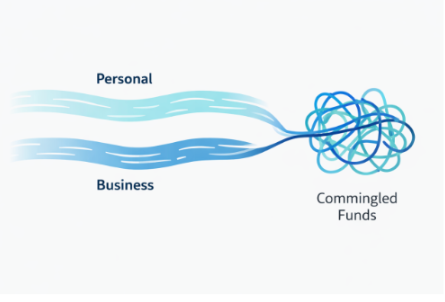
Opening a separate business checking account is the single most effective administrative step you can take as a self-employed person or small business owner. It is the foundation that everything else is built on.
When every transaction in that account is business-related, there is no guesswork. Your CPA can look at one statement and see the full picture. Every deductible purchase is accounted for without anyone having to play detective.
It also simplifies your bookkeeping significantly. Accounting software works the way it’s supposed to when your business finances live in one place. And if the IRS ever questions your business activity, a dedicated account with clean records is one of the strongest signals that you are running a legitimate operation.
Mistakes happen even with the best system in place. The key is having a simple process to catch them before they disappear.
The moment you pay for a business expense with a personal card, write it down. The date, the vendor, the amount, and what it was for. A note in your phone works perfectly well.
Once a month, add up all those personal-paid business expenses and transfer that exact total from your business account back to your personal account. Label the transfer “Owner Reimbursement” followed by the month. That’s all it takes. The expense is now properly recorded on the business side and nothing gets lost.

If this year’s tax season already feels like a scramble, it’s okay. You can’t fix the past few months overnight, but you can make sure next year looks completely different.
Start by opening a dedicated business checking account. Many banks offer no-fee options for small businesses and the process takes less than thirty minutes online.
Once the account is open, update your clients to send payments there. Switch your recurring business subscriptions and software billing over to your new business card. From that point forward, all business income goes in and all business expenses come out of that one account.
When you slip up and use the wrong card, use the reimbursement process. It keeps your books clean without requiring perfection.
Giving your business its own financial home is one of the simplest and highest-impact things you can do as a business owner. It makes tax season manageable, protects your deductions, and gives you a clearer picture of how your business is actually performing all year long.
The business owners who feel most confident about their finances are rarely the most sophisticated. They’re usually just the ones with clean, consistent habits and the right systems in place from the start.
If you’re ready to stop the annual scramble and build something that works for you instead of against you, it starts with something as simple as opening a new account.